Research
Two labs, one question.
Both of my research appointments come back to the same problem: a diagnostic test is only useful where it can actually be run. One line of work makes the separation step better; the other removes the equipment the test needs to exist.
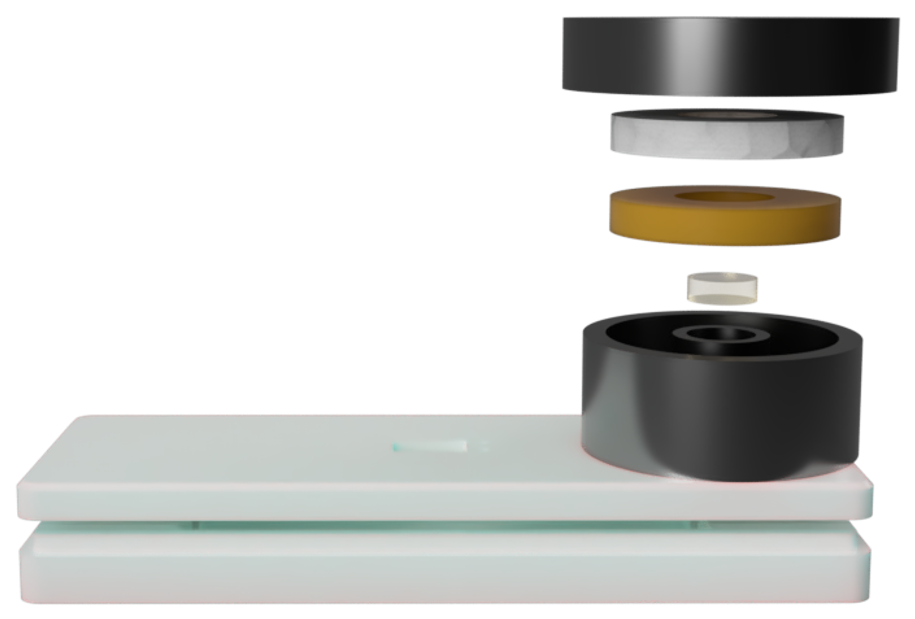
Passive Thermal Control for an Infrastructure-Free Diagnostic Cassette
PI: Prof. Firat Güder, Department of Bioengineering. A single-use cassette that holds an isothermal DNA amplification reaction at 37–42 °C for ~11 minutes on stored chemical energy alone, then releases product to a lateral flow strip on a timer made of material.
Read the project →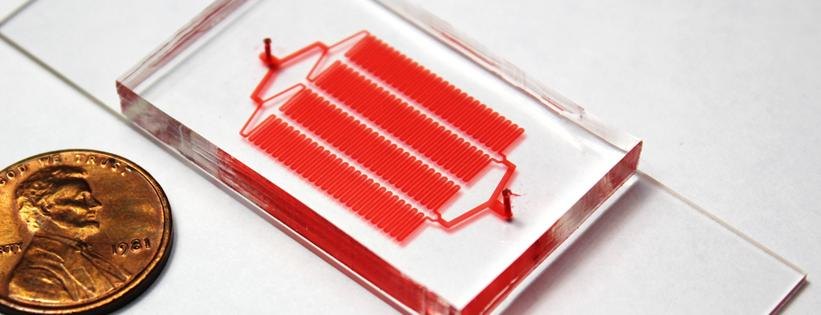
Lateral Filter Array Microfluidics for Circulating Tumor Cell Isolation
PI: Prof. Z. Hugh Fan, Interdisciplinary Microsystems Group. A COMSOL model relating channel geometry and flow rate to capture efficiency, validated across 200+ fabricated devices and clinical samples from UF Health Shands Hospital.
Read the project →Context
Why these two sit together.
A molecular diagnostic has three hard parts: get the target out of a messy sample, amplify it enough to see, and read the result. Each one normally demands its own instrument, and every instrument you add is another reason the test never leaves a hospital.
The Florida work attacks the first part. A lateral filter array separates rare cells from whole blood by geometry rather than by centrifuge, and if you can predict capture efficiency from channel dimensions you can design the device instead of iterating blind. The London work attacks the second and third. If a hydration exotherm can hold a reaction at temperature and a swelling membrane can time the transfer, the amplification step stops needing a heater and a technician.
I am interested in the version of this where all three parts fit in something disposable. My current project at UF, a sequential reagent release platform using microfluidic ball valves for multiplexed HIV, dengue, and Zika detection, is the first attempt at stitching them together.
Contact
Questions about this work?
- noah.haeske@ufl.edu
- Phone
- 407-705-9895
- Resume
- Download PDF