Noah Haeske Mechanical Engineering

← Projects  /  Florida Rocket Lab  /  In progress

Supersonic Active Control Testing Vehicle

This is what I am working on now. A Mach 1.5 subscale vehicle whose job is to fly active canard control through the transonic transition, so the controller meets that transition on a cheap airframe instead of on the full-scale one.
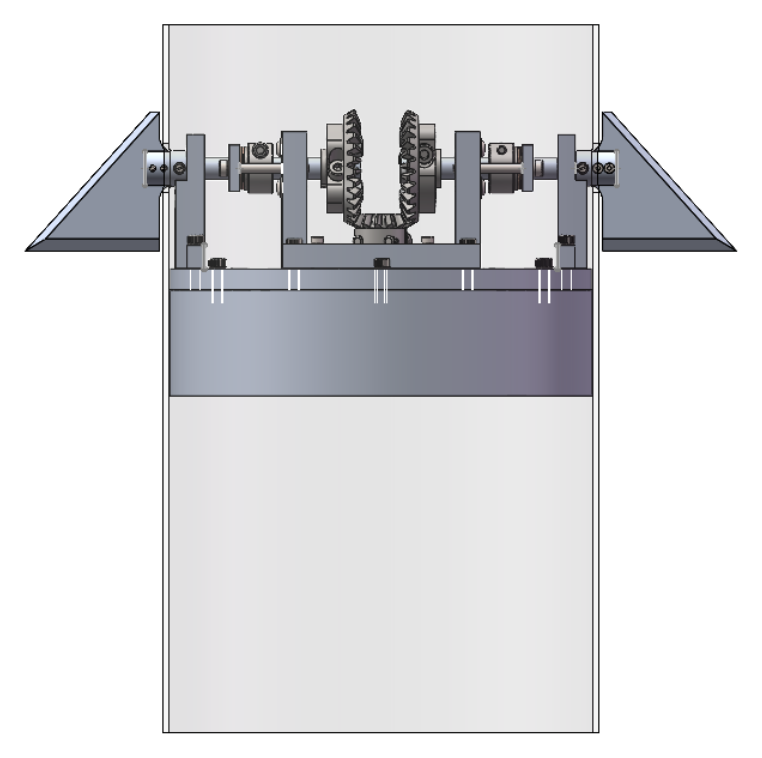
CAD side view of the canard actuation mechanism inside the body tube: a central bevel gear set drives shafts out through bearing blocks and shaft collars to the two canards on either side of the airframe, all mounted on a bulkhead
Fig. 1  Canard actuation mechanism, side view. The gear set at the center drives the shafts that run out through the airframe wall to each canard.
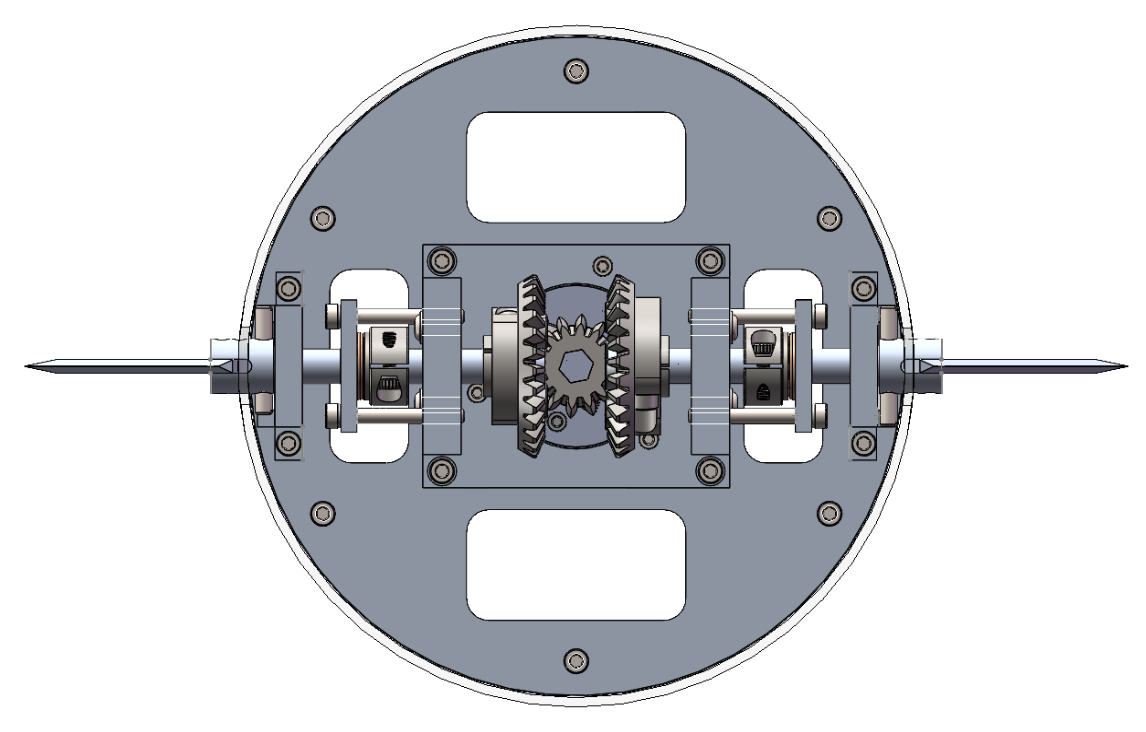
CAD overhead view of the canard actuation mechanism on its circular bulkhead: a center pinion between two bevel gears, shafts supported by bearing blocks running out to the canards on each side, and two rectangular pass-through cutouts in the plate
Fig. 2  The same mechanism from above, on its mounting bulkhead.

Status · active

Stage
Preliminary design review
Organization
Florida Rocket Lab, University of Florida
Role
Flight Vehicles Engineer
Started
2026–27 vehicle cycle

PDR baseline

Length
98 in
Max diameter
6.17 in
Mass with motor
76.8 lb
Mass without motor
44.3 lb
Target
Mach 1.5
Static margin
1.52 cal at M = 0.3

Why fly it small first

I designed a subscale solid-motor test vehicle that reaches Mach 1.5, built to validate active canard control across both subsonic and supersonic flight regimes. Canard authority changes character as the vehicle goes transonic, so a control scheme that behaves on paper still has to be flown; the subscale vehicle is the cheapest way to put the controller in front of that transition before it flies on the full-scale airframe.

The subscale keeps the parts of the full-scale vehicle that the test is about and drops the parts that make it expensive. The nose cone, recovery, avionics bay, and the fin can carry over. The liquid propellant tank and motor come out and are replaced by a solid motor.

This vehicle is currently under preliminary design review with full build expected in mid to late fall 2026.
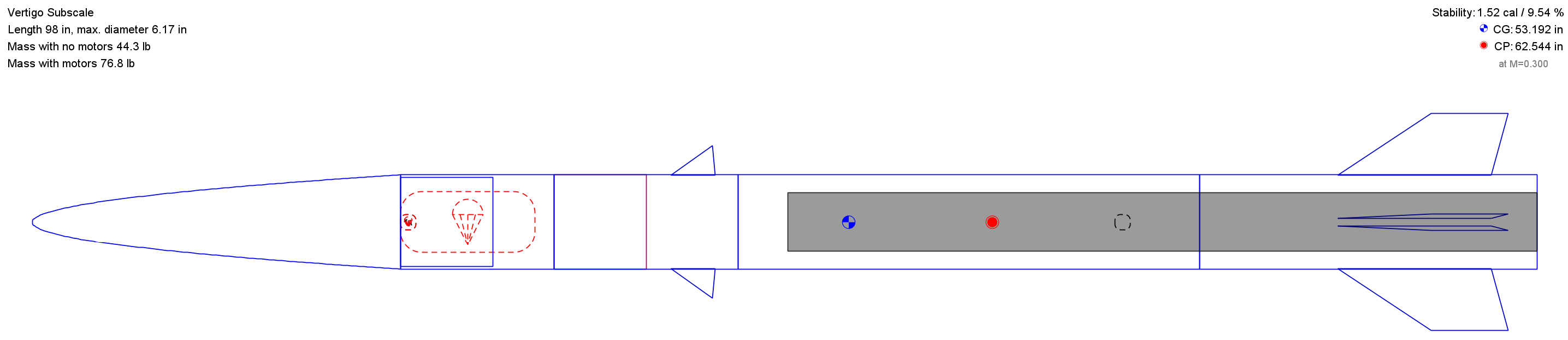
OpenRocket side view of the Vertigo Subscale vehicle: 98 in long, 6.17 in maximum diameter, with the recovery bay behind the nose cone, canards forward on the airframe, the solid motor running to the tail, and the aft fins. CG marked at 53.192 in and CP at 62.544 in; 1.52 cal of stability at M = 0.3.
Fig. 3  Current OpenRocket layout. The forward set of fins is the canard control surface; CG at 53.2 in and CP at 62.5 in give 1.52 cal of static margin at M = 0.3. Mass is 76.8 lb with the motor and 44.3 lb without.
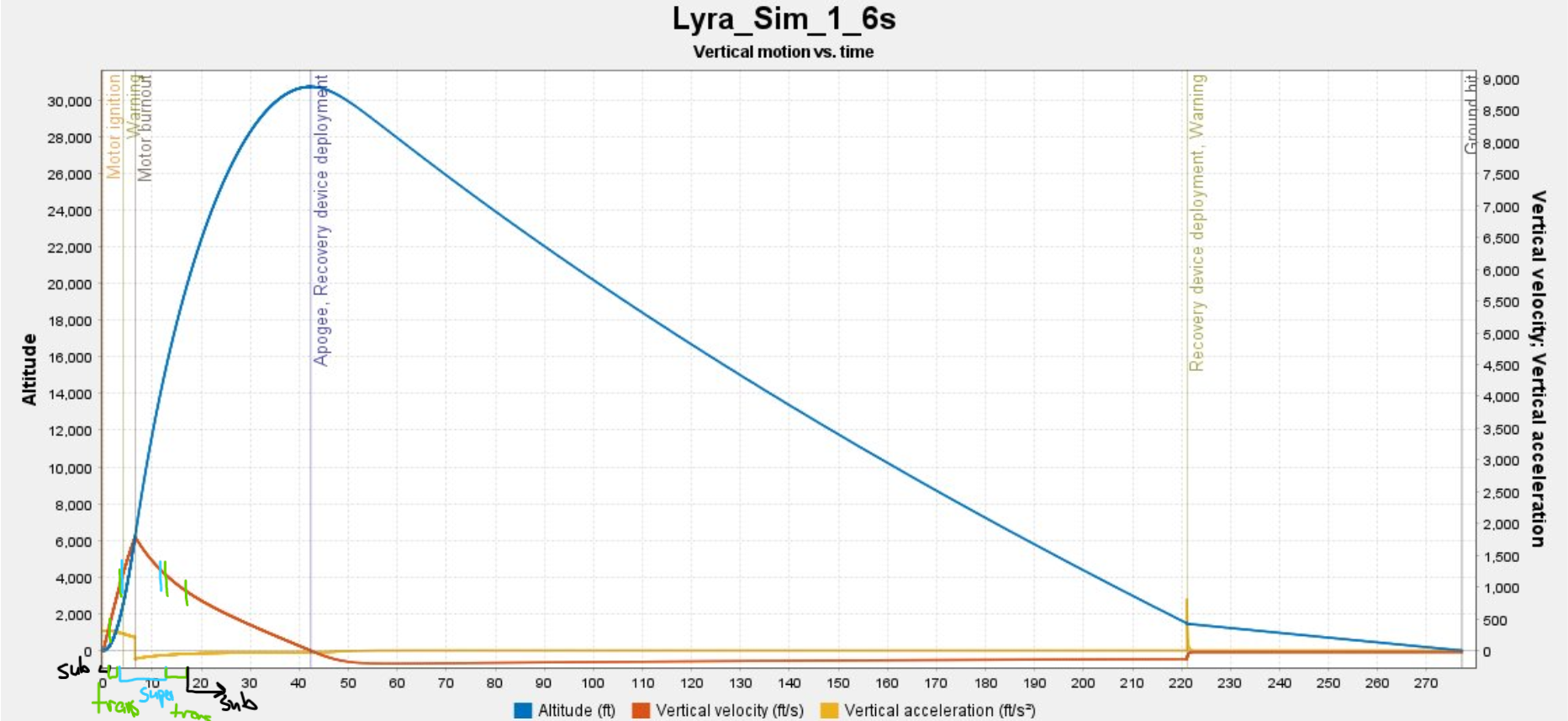
OpenRocket simulation of the full-scale vehicle: altitude, vertical velocity, and vertical acceleration against time. Altitude peaks near 30,800 ft at about 42 s; velocity peaks near 2,000 ft/s at motor burnout around 6 s. Hand annotations along the time axis mark the subsonic, transonic, supersonic, transonic, and subsonic phases of the boost and coast.
Fig. 4  Simulated flight profile of the full-scale vehicle. The annotations along the time axis mark where it passes from subsonic through transonic to supersonic and back down. The subscale is built to recreate this profile, so its systems see the full range of dynamics the full-scale vehicle will.

What comes next

Currently I'm validating the thrust structure in Ansys Mechanical, and designing tooling for the carbon fiber layup this rocket will use as it's body. As the design passes review, gets fabricated, and flies, this page fills in: structures and recovery detail, the canard actuation and control work, and flight data against the predictions above.
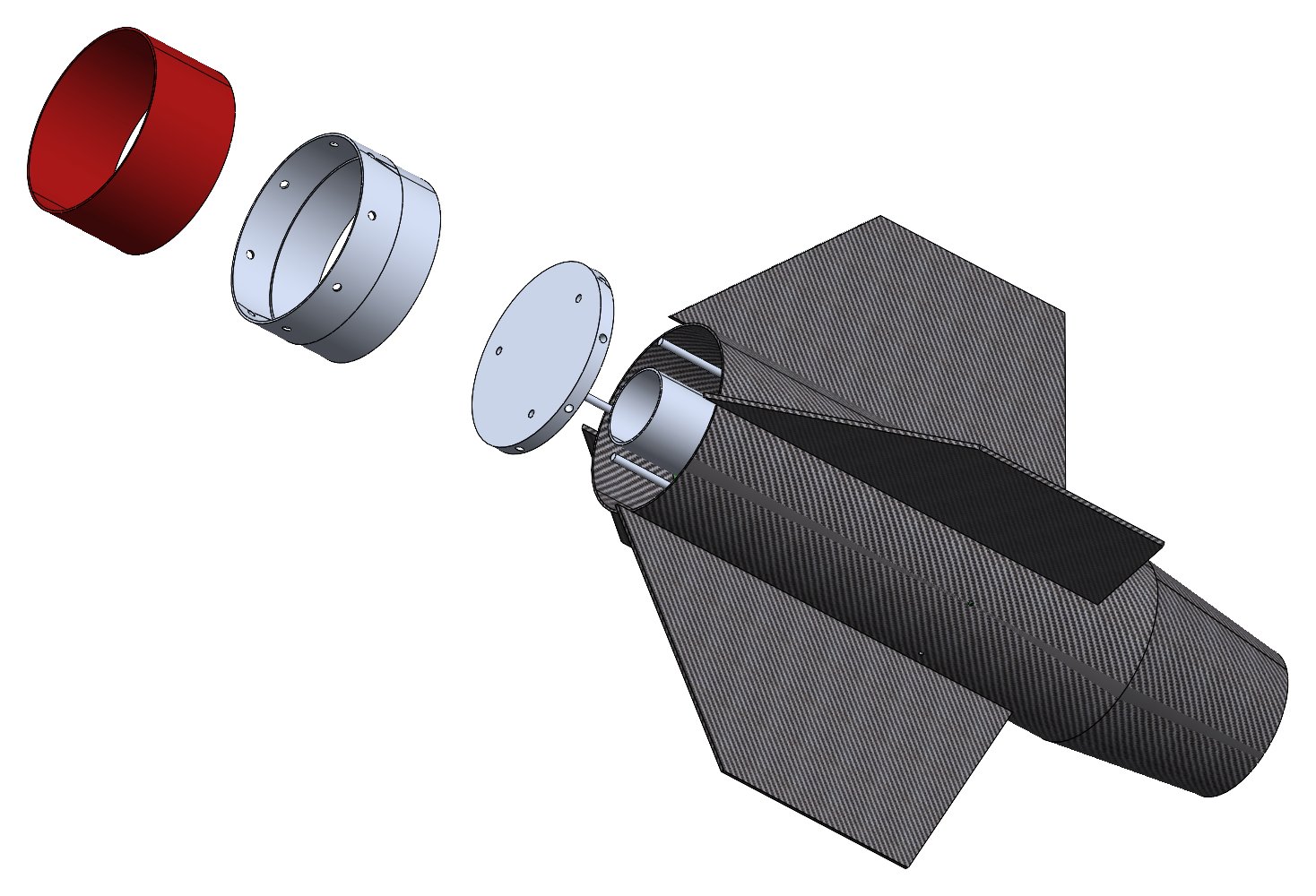
Exploded CAD view of the work-in-progress solid motor thrust structure: a red coupler ring, a perforated ring, and a bolted bulkhead plate ahead of the carbon fiber aft section, which carries the motor tube on standoff rods, the fins, and the tapered boattail
Fig. 5  Work in progress: the solid motor thrust structure, designed to integrate with the forward sections of the full liquid vehicle.